
Player guide
Refinance and sell
Buying a building is the setup. The payoff comes later, two ways: pull cash out with a refinance, or sell it for a cheque.
Updated October 20, 2026
Refinance: the cash-out
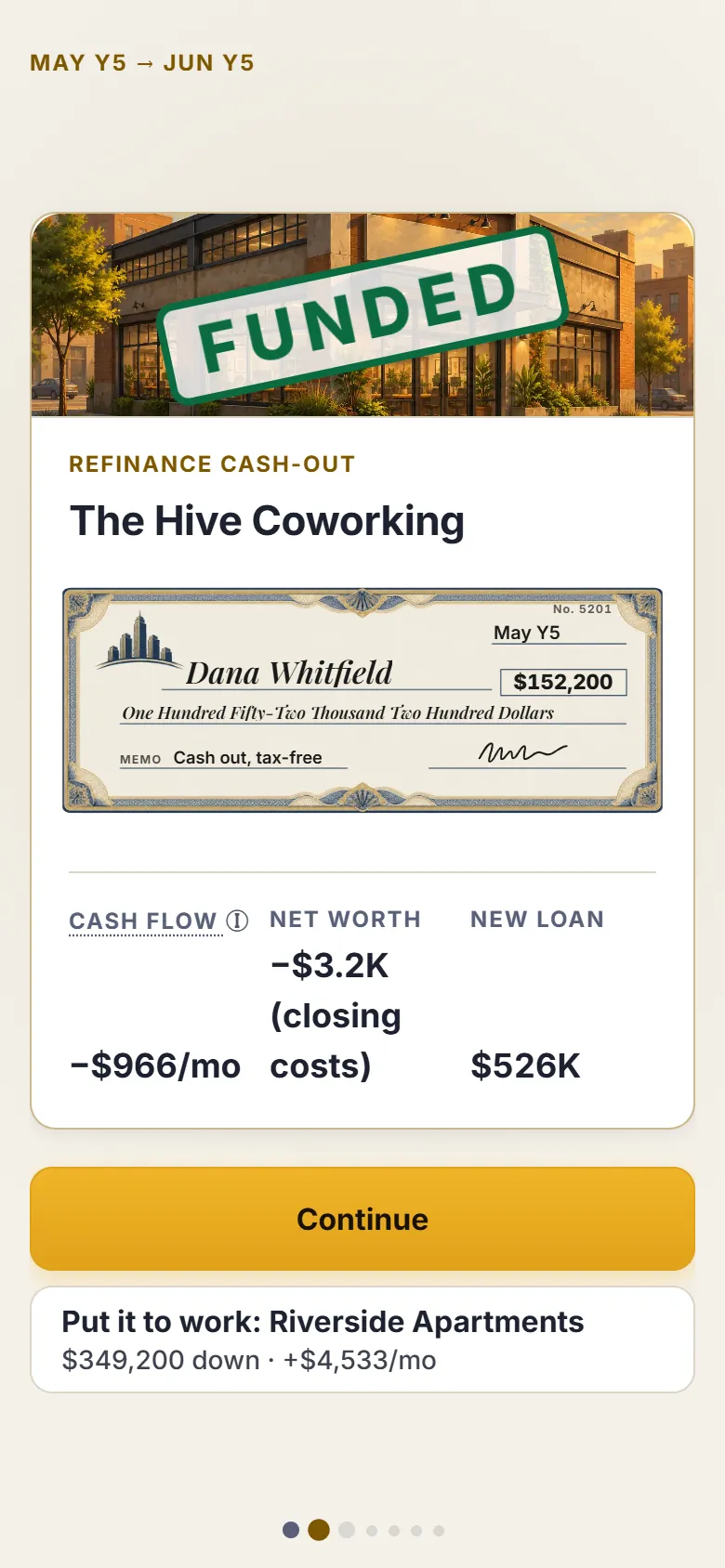
A refinance replaces your loan with a bigger one, based on what the building is worth now. The new loan pays off the old one, and the difference comes to you as cash. Borrowed money isn't income, so a cash-out refinance is tax-free, and you keep the building and its rent.
The lender has rules:
- The building has to be stabilized: leased up and at least 90% occupied. That's what the business plan is for.
- You've owned the building at least 6 months.
- The rent has to cover the payment on the new, bigger loan 1.25 times. On a thin building that rule, not the value, sets the size of the loan.
- The building can't be listed for sale or in escrow.
- After a refinance you wait 12 months before the next one on the same building, and a building can be refinanced 2 times at most.
The new loan is 70% of the building's value, or less when the rent can't cover a loan that size 1.25 times. From that come the old loan and 1.5% of the value in costs; the rest is yours. The rate is today's market rate, so a refinance is partly a bet on timing: see The market.
Every refinance that funds raises your Finance skill a level, which takes a little off the rate of every new loan and refinance. At level 5, refinances lend up to 75% of the value, and the costs are halved.
When a building is ready, a Cash out? card shows what a refinance pulls out and what selling would pay, side by side. Choose Refinance and it costs an action, then funds when the month ends. The money arrives in the month-end reveal as a cheque to deposit, and a big one can make the front page of the Skyline Herald.
Selling
You can list a building after you've owned it for 4 months. Open it in your Portfolio, pick a strategy (Quick Exit, Balanced or Premium) and an asking price, and list it. Listing costs an action. Offers arrive over the following months on the Pipeline tab, and you answer them the way you would for a client: Accept, Counter at asking or Pass. An accepted offer goes into escrow and closes like any other deal. Once Standing Orders open (see Brokerage), you can let good offers on your own listing be accepted for you, too.
Hot listings
The market keeps moving while your building is listed. If it runs past your asking price, your listing turns hot: buyers line up, more offers come in, and some come in at or over asking. The offer card and the building's page both show where the market is now, and a Raise your price button that lifts your asking price to match. Offers already on the table stay; new ones come in at the new price. Nothing raises it for you. It's your call.
What a sale pays you
The sale price, less:
- Selling costs of 4%: closing costs, transfer tax and the buyer's broker.
- The loan you still owe.
- Capital-gains tax on your profit, at a rate set by how long you held the building:
| Held for | Tax on the profit |
|---|---|
| Under 12 months | 40% |
| 12 to 35 months | 20% |
| 36 to 59 months | 15% |
| 60 months or more | 0% |
Quick flips pay the most tax. Hold a building 5 years or more and the profit is tax-free. The Cash out? card and the building's page show what a sale puts in your pocket after all of this, before you list. The sale's cheque arrives in the month-end reveal.
Hostile offers and boss bids
Sometimes a rival broker wants one of your buildings and makes an offer you didn't ask for. The card shows their price and the cash you'd keep. Not for sale turns them away; Sell to them takes the money.
From year six, each year can open a boss season against the strongest rival still racing you. During it, they make boss bids for your buildings in their district: over the building's value, but selling hands them turf in your race. See The market.
Refinance, sell, or hold?
Each building's page has a hold-or-sell line: what a sale puts in your pocket today, and what holding it 24 more months is worth against that. It counts the cash flow over those months, the rent growth, the loan paid down, the lower tax of a longer hold, and any big repair bill coming due. Sometimes it says hold; sometimes holding leaves you worse off.
- Refinance when you want cash for the next building and the one you have still earns well. No tax, and the rent keeps coming.
- Sell when the market is hot, the building is held long enough for the lower tax, or it's the cheque that gets you a much bigger building.
For your score, it's closer than it looks. Your net worth already counts each building at what a sale would pay you, so selling doesn't raise your score by itself. What you do with the money does. See Career and score.
Try it on a real career
Free in your browser, on your phone or desktop. No download, no account.