
Player guide
Buying and financing
Commissions are fast money. Buildings are where it compounds. Here's how an offer becomes a building you own.
Updated October 20, 2026
The Market tab
Your first commission opens the Market. It lists the buildings for sale right now in the districts you've unlocked, with their price, occupancy and income, and your purchases under contract. The list changes every month: new buildings come up, overpriced ones get price cuts, and rival brokers buy the bargains you leave sitting (see The market). You can browse every building in the game on the Buildings page.
Now and then a card on the Desk also suggests a building you can afford, with an Offer button. Those offers go in at 95% of asking (the starter duplex at 90%) with 35% down on a bank loan.
The Deal Sheet
Tap a building to open its Deal Sheet. It reads top to bottom:
- One line on top: "You put in" your cash down, and "It pays you" what the building leaves you each month after the loan, with how many years the cash takes to come back. It updates as you change anything below.
- Your offer. Pick a price from −10% to +5% of asking, or step it. Your very first purchase opens at Ask; later ones open at 95% (the starter duplex always at 90%). Beside it, the seller's likely answer in plain words, from "yes" to "probably not", and whether they'd counter or walk if not.
- How you pay. Three loan rows (the bank, hard money and a private lender), each with its rate and down payment, or a locked row that says what opens it. Then the cash down, or all cash.
- The building and The numbers, folded: cap rate, occupancy, rent after costs, the loan payment and the coverage ratio, for when you want the detail.
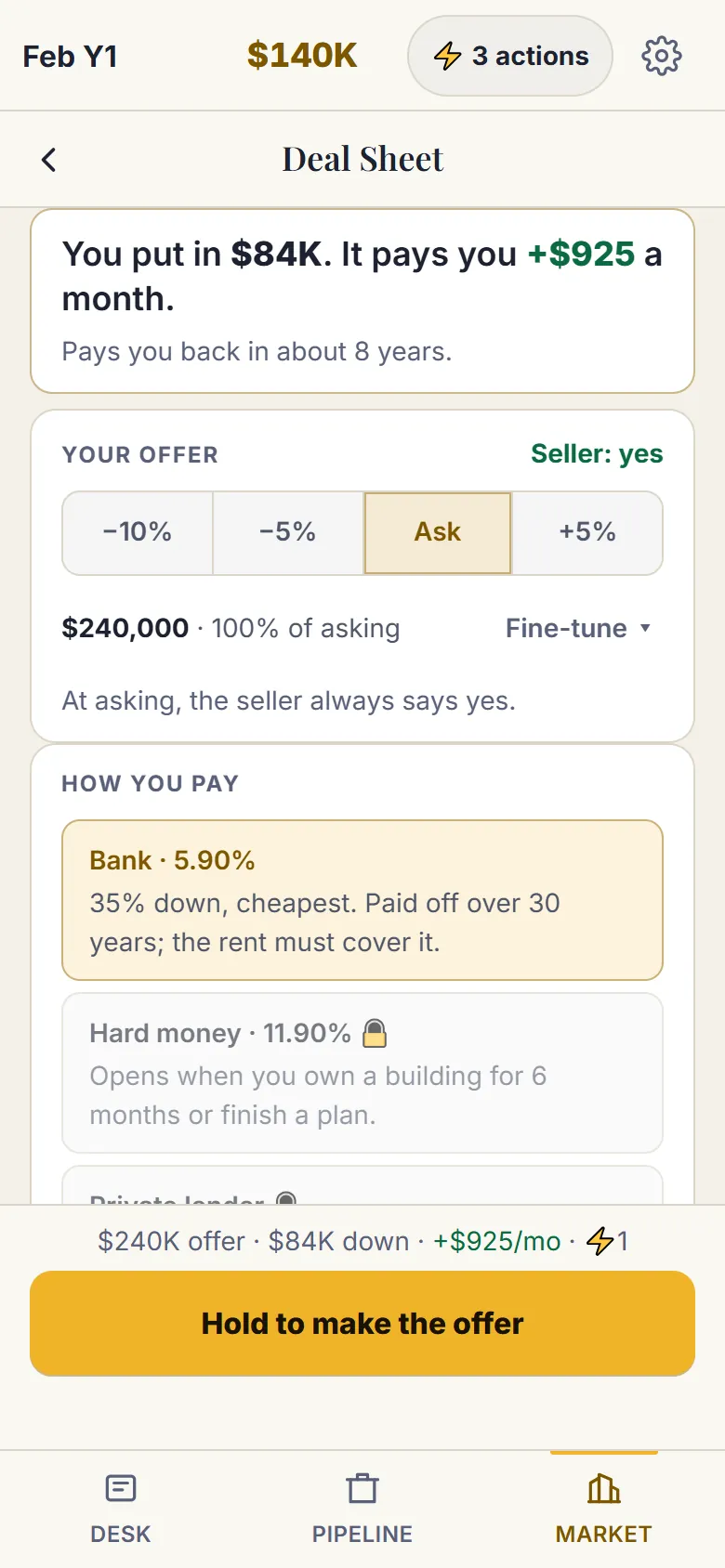
When the numbers work, Hold to make the offer (on a computer, click it and click again to confirm). If the building would lose money each month, the game asks you to confirm first. An offer costs an action (3 with a private lender).
How the loans work
- The bank lends up to 65% of the price and is open from the start. Its loan is paid down over 30 years: each payment is interest plus a little principal, so the balance falls every month.
- Hard money lends up to 80% and opens once you own a building for 6 months or finish a plan. It ignores the coverage test, costs a lot more in interest, is interest-only, and comes due in 24 months.
- Private lenders open once you refinance or sell a hard-money building. They're people you meet: 8 of them, from small family offices to a fund that lends $40M. Each lends on one or two kinds of building, up to their own limit, at their own rate and 75% to 82% of the price (18% to 25% down). Each holds one loan at a time, and a loan repaid raises their limit. You meet the first when the private lender opens, and more at the Networking Gala and the VIP Room. Their loans are interest-only and come due in 36 months.
Refinance or sell a hard-money or private building before its loan comes due, or the lender charges 18% (14% on a private loan) until you do. Landmarks, the 21 buildings from $62M to $250M, finance through the bank only, or all cash.
Rates are priced off the market's benchmark rate, which moves with the cycle, so the same building can be cheaper to finance one year than the next.
The Finance skill
Every refinance that funds and every loan you pay off raises your Finance skill one level, up to 5. Each level takes 0.05 points off the rate on new loans and refinances, shown beside the rate. At level 5, refinances also lend more for less (see Refinance and sell). You'll find it on You.
The bank's coverage test
The bank checks the debt service coverage ratio, or DSCR: the building's yearly income divided by the yearly loan payments. It looks at the income the building will make once it's full, trims it by 10% to be safe, and wants a ratio of at least 1.2. In plain terms, the rent has to cover the loan. If it doesn't, the sheet tells you, and offers a mix of down payment and lender that would pass.
Accepted, countered or refused
An offer at or over asking is always accepted. Below asking, it depends on the seller: an emptier building, a weaker class, and a building that has sat on the market for a while all make a seller more willing to deal. Your negotiation skill helps too. A seller who turns you down will often counter somewhere between your offer and their price. The counter page offers each loan you qualify for, with its own down payment: accept on the one you want, or Walk away. Lowball hard and some sellers won't negotiate at all.
Closing at month end
An accepted offer is under contract, and your down payment is held. The purchase closes when you end the month. Before it does, the building is inspected. Most inspections are clean, and sometimes the seller even gives you a credit for small things. If the inspection finds a real problem, nothing closes until you decide:
- Ask for a credit and the seller may take the repair cost off the price,
- Close anyway and pay for the fix yourself after closing,
- or Walk away and lose a small earnest deposit.
Inspections find more problems in hot markets, and sellers give credits more readily in weak ones.
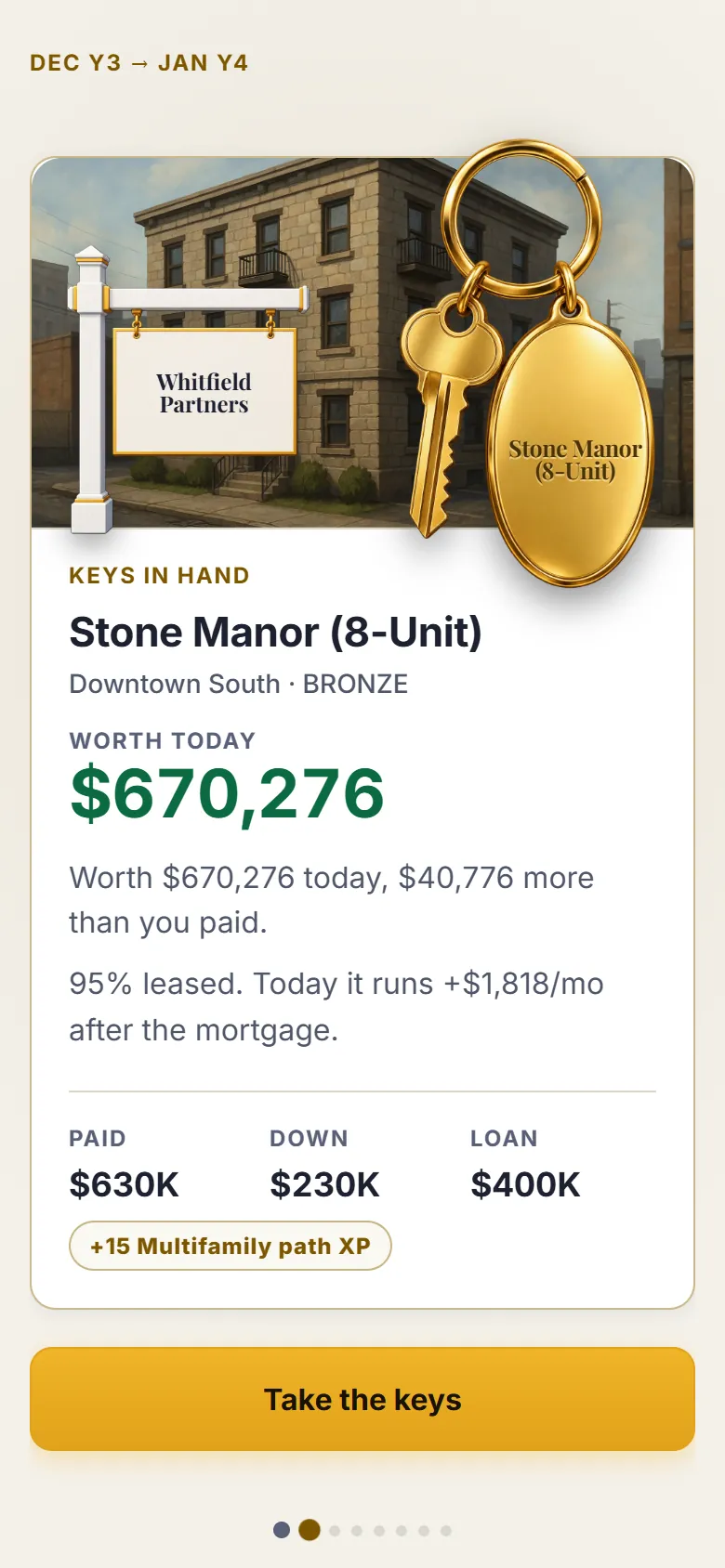
When it closes, the month-end reveal hands you the keys. The building joins your Portfolio and starts paying rent the next month.
Next: pick a business plan
A new building's first real decision is how you'll run it. Without a plan it never fills past 80% and its value slides. The plans run from a quick Fix-Up to a full Redevelop: read Business plans. Then Upgrades push its value further, and Refinance and sell turns it into cash.
Try it on a real career
Free in your browser, on your phone or desktop. No download, no account.